
Run the business first.Risk the money later.

Describe your company. AI staff run it like the real thing, day after day, and show you what makes money, how, and why.

Try:

Free to start. None of the money is real.

Sunrise Laundry, running by itself
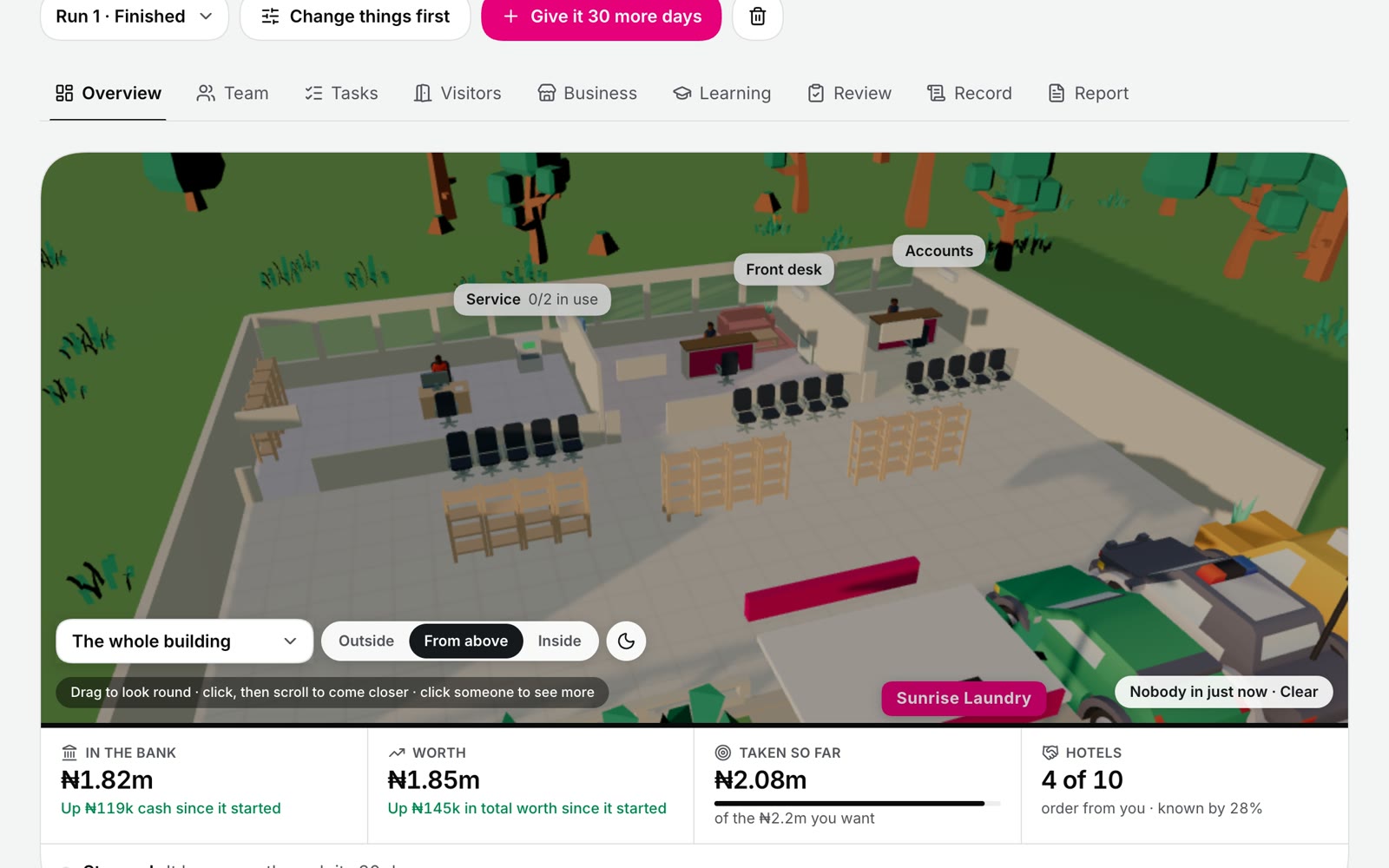
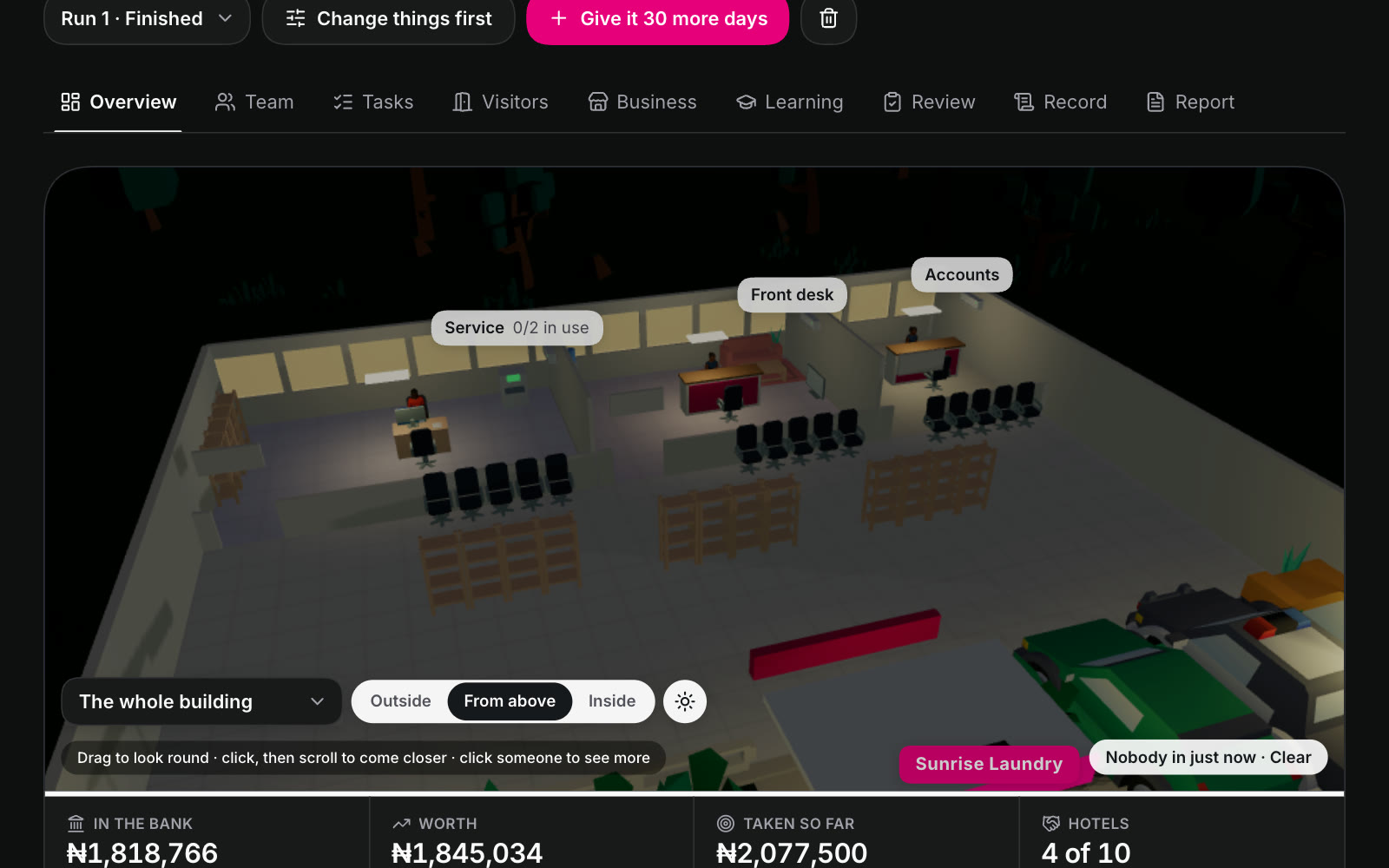
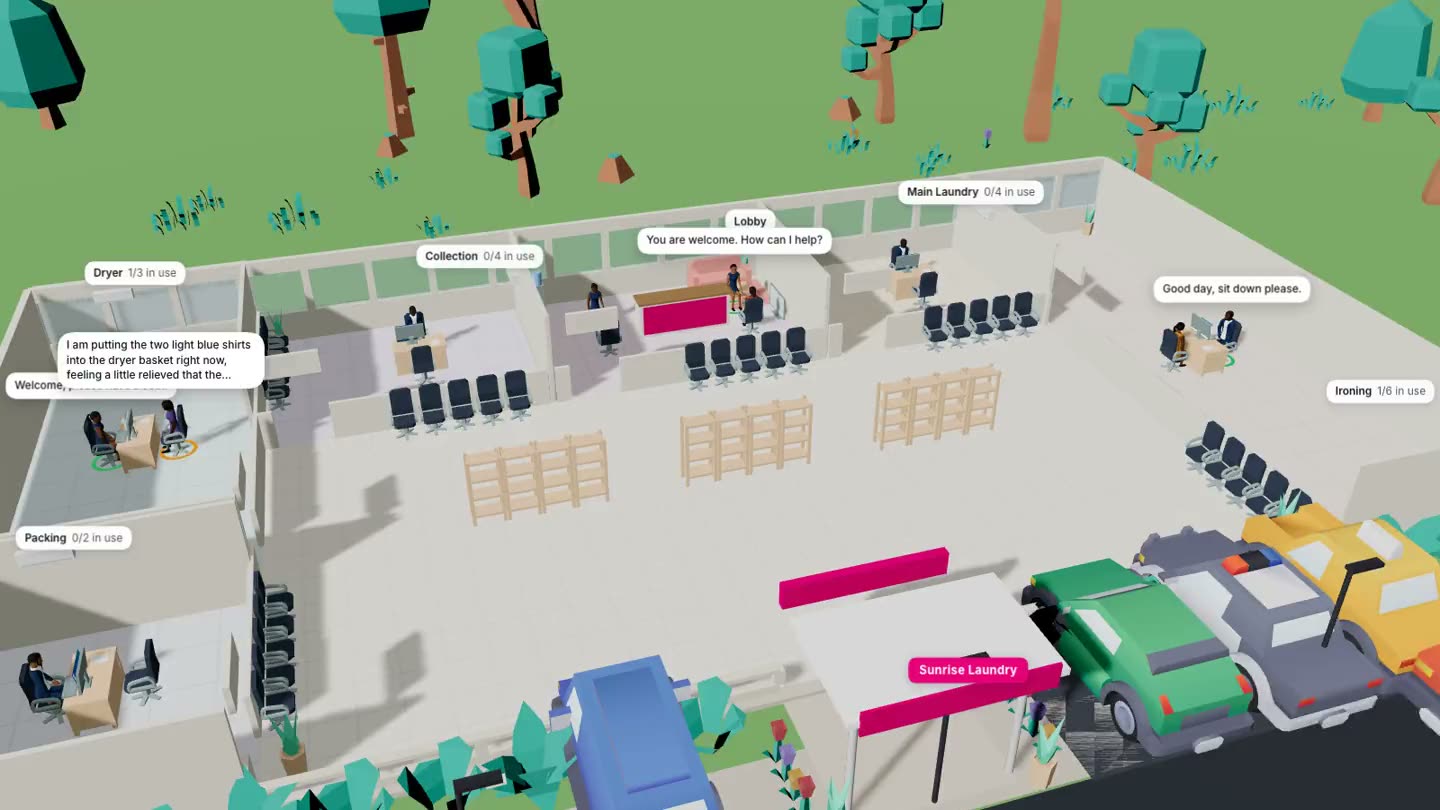
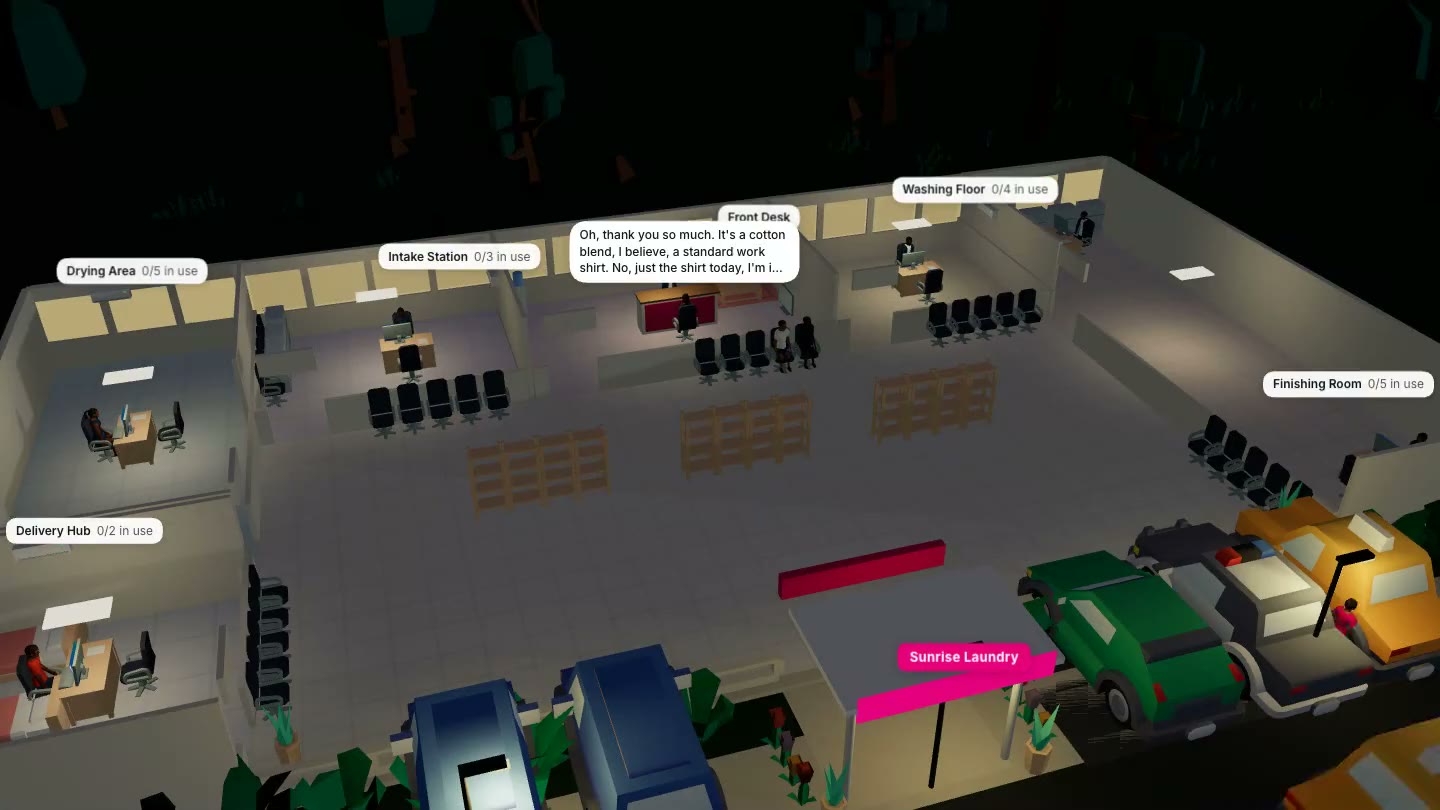
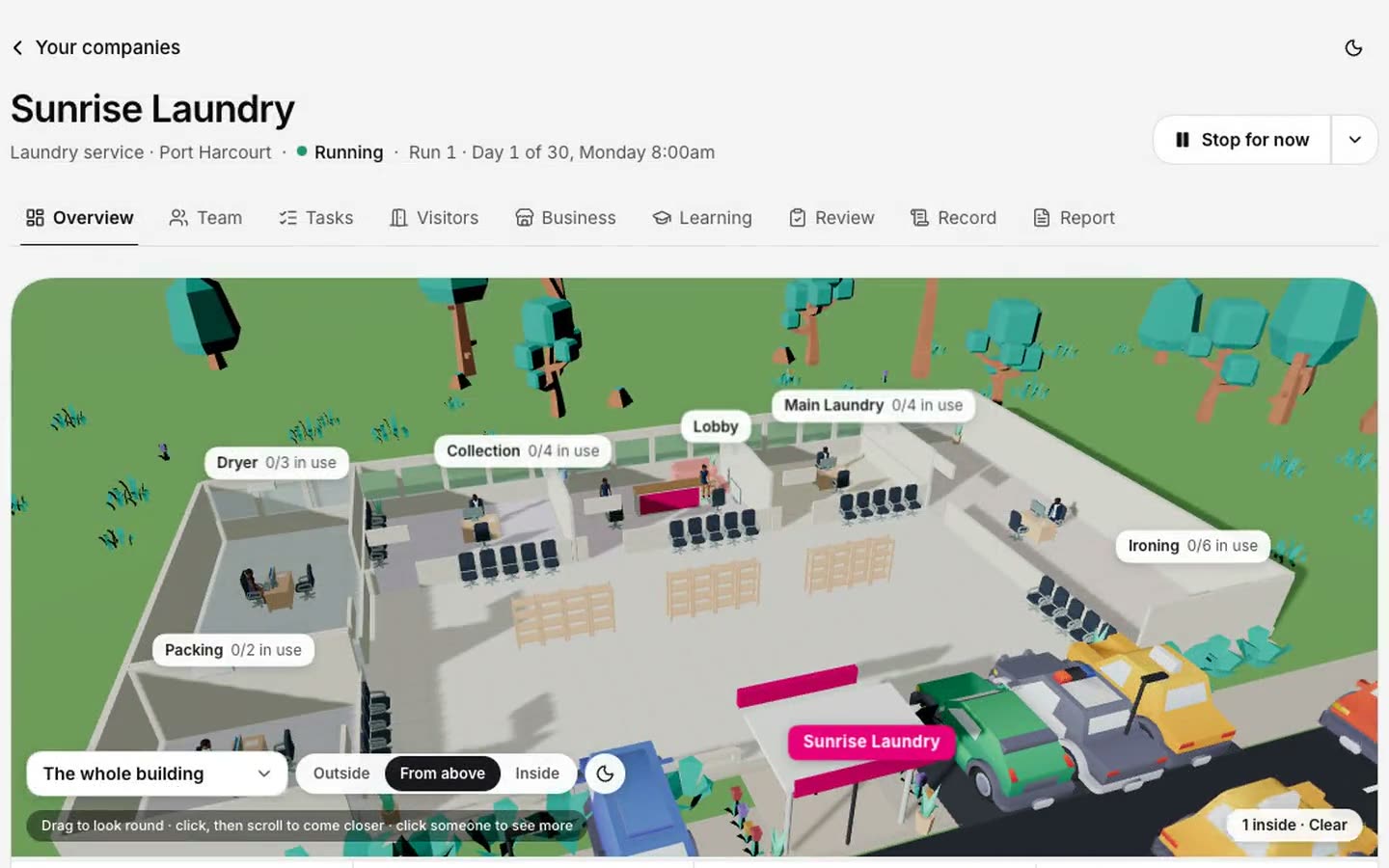
A laundry seen from above with its roof off: the front desk, the washing and ironing rooms, staff at their desks and customers walking in, with cars parked outside.A laundry seen from above with its roof off: the front desk, the washing and ironing rooms, staff at their desks and customers walking in, with cars parked outside.

Ibrahim Musa · Day 3Won Woji Bay Hotel: about 12 kilos every working day.

A woman on a street in the early evening, arms folded, looking across at an empty shop with its shutter down.

Opening a business is the one big decision you never get to practise. You rent the shop, buy the machines, hire the people, and find out six months later whether you were right.

Livar gives you the six months first.

Before you enter a market

Try your company in another city first.

A second branch, a new country, a city you have never worked in. Name it, and your company is set up there: local prices, local wages and rent, local people to hire, all in the money of that place. Run it for a month and see whether it pays before you spend anything there.

Here is one laundry, described once and set up in four cities: “Wash, dry and iron laundry for homes, students and small hotels, with pick-up and delivery.”

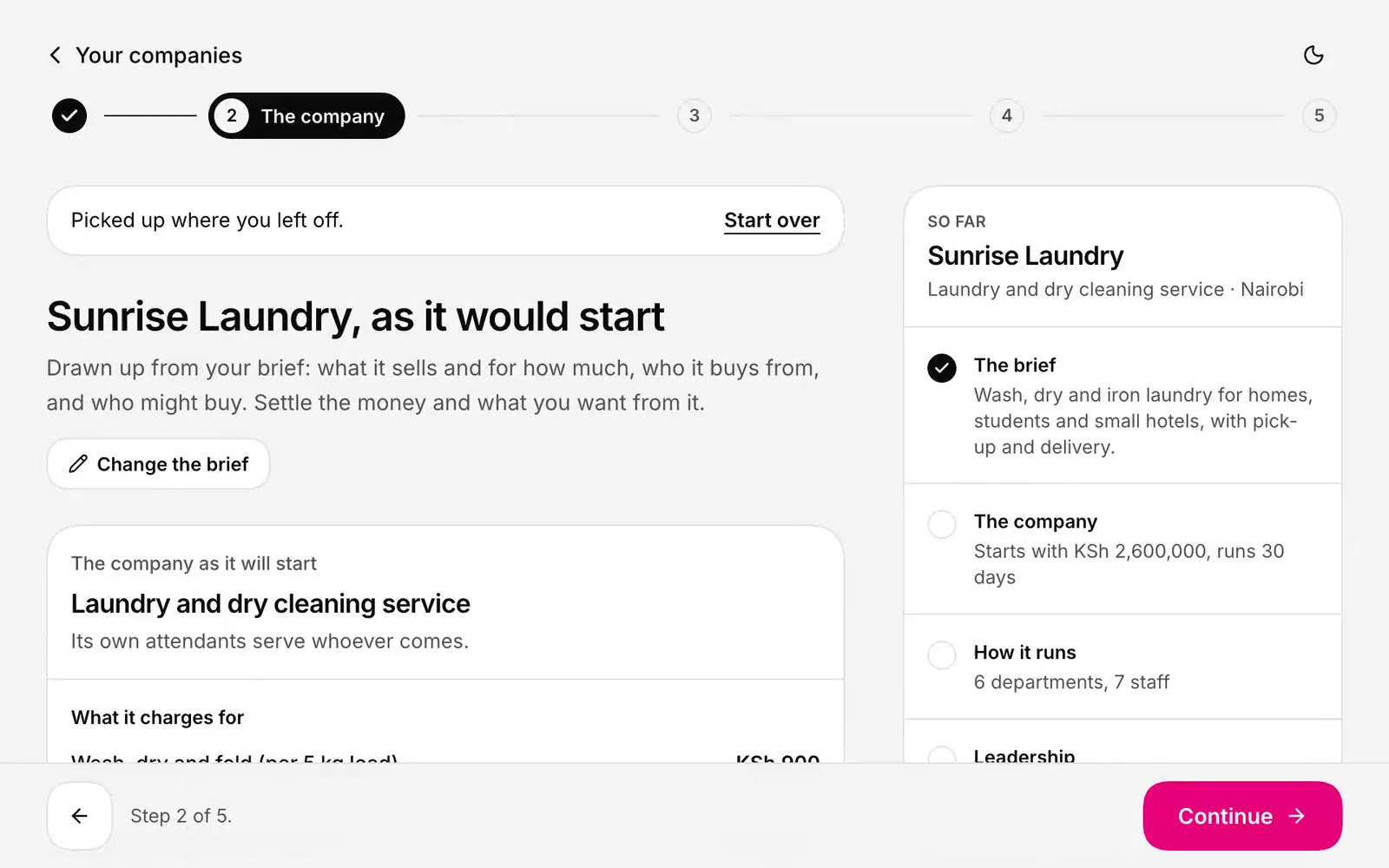
Sunrise Laundry in Nairobi, as it would start
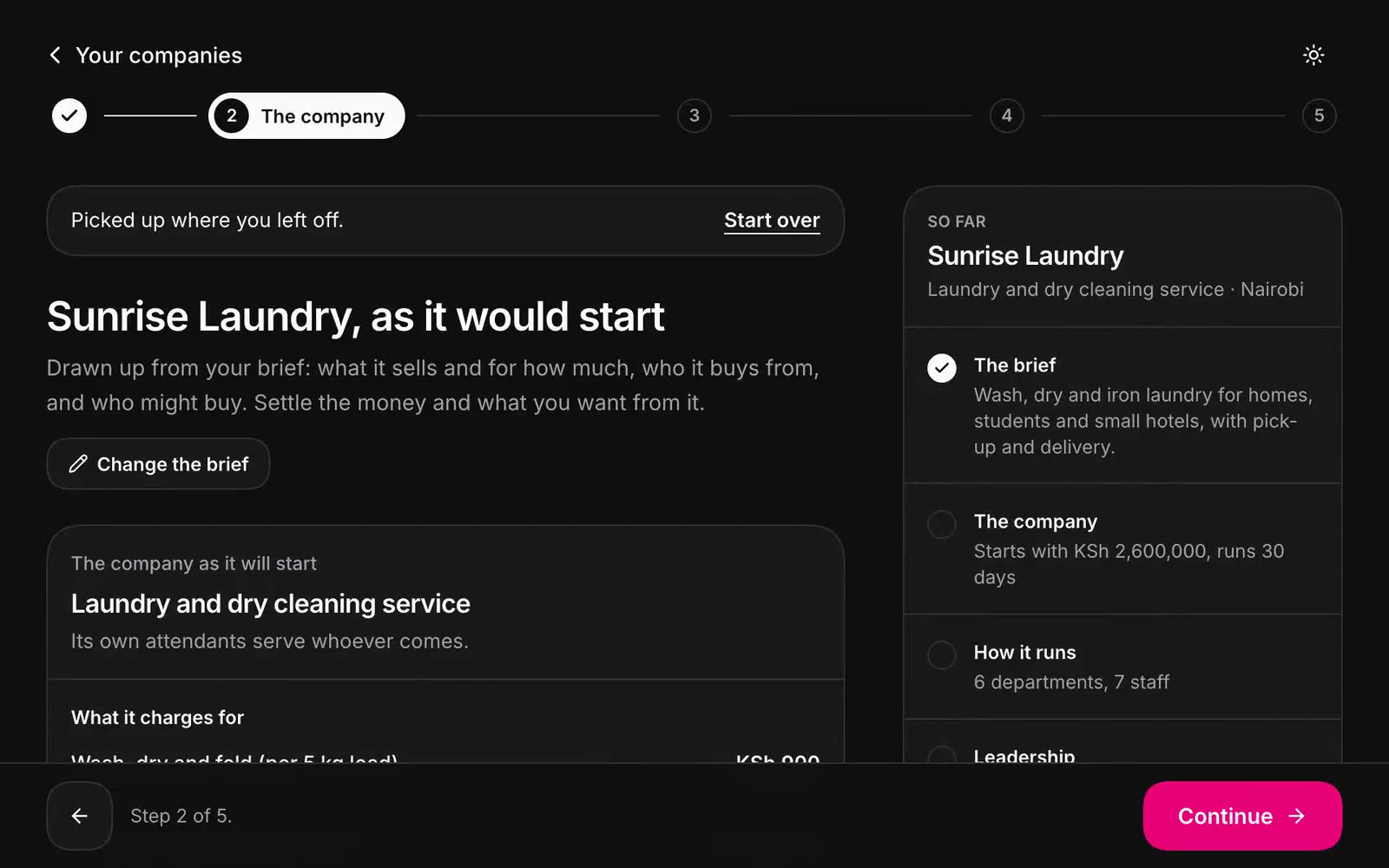
The company as Livar drew it up for Nairobi: what it charges, in kenyan shillings, what each service costs to provide, and who it buys from there.The company as Livar drew it up for Nairobi: what it charges, in kenyan shillings, what each service costs to provide, and who it buys from there.
  • Priced for the place.

    Every price, wage and rent is in the money of the city you name, at what things cost there. Nothing is converted from somewhere else.

  • Staffed by people there.

    The people you hire have the names people there have. Your suppliers and the regulars you could win are businesses of that city.

  • Compare cities on one number.

    Each company keeps its books in its own money. What you gained or lost on what you put in is a percentage, so Nairobi can be read against Manchester.

One laundry as it was drawn up in four cities
WhatNairobiKenyaManchesterUnited KingdomSão PauloBrazilPort HarcourtNigeria
Counts inKenyan shillingsPounds sterlingBrazilian reaisNigerian naira
Wash and ironKSh 1,300a 5 kg load£24a bundleR$110an 8 kg load₦1,500a kilo
What that costs to doKSh 260£4.10R$18₦300
People and rentKSh 21,100a day£210a dayR$964a day₦17,100a day
A fair startKSh 2,600,000£26,000R$120,000₦2,100,000
A good month takes inKSh 1,700,000£16,000R$72,000₦1,400,000
Could be led byNaledi NkosiHannah ClarkeIsabela OliveiraYetunde Fashola

These are real set-up screens, one for each city. They show where your company would start there. How it does from there is what you run it to find out.

A real run, start to finish

Thirty days at Sunrise Laundry.

A laundry in Port Harcourt that exists only in Livar. Everything below is the product itself, and every figure, decision and reason is copied from the company’s own record.

  1. 1
  2. 2
  3. 3
  4. 4
  5. 5
  6. 6
  7. 7
  8. 8
  9. 9
  10. 10
  11. 11
  12. 12
  13. 13
  14. 14
  15. 15
  16. 16
  17. 17
  18. 18
  19. 19
  20. 20
  21. 21
  22. 22
  23. 23
  24. 24
  25. 25
  26. 26
  27. 27
  28. 28
  29. 29
  30. 30

Worth less than it started with Worth more Day 30: ₦118,766 up

  1. 01Minute one

    You say it in a sentence.

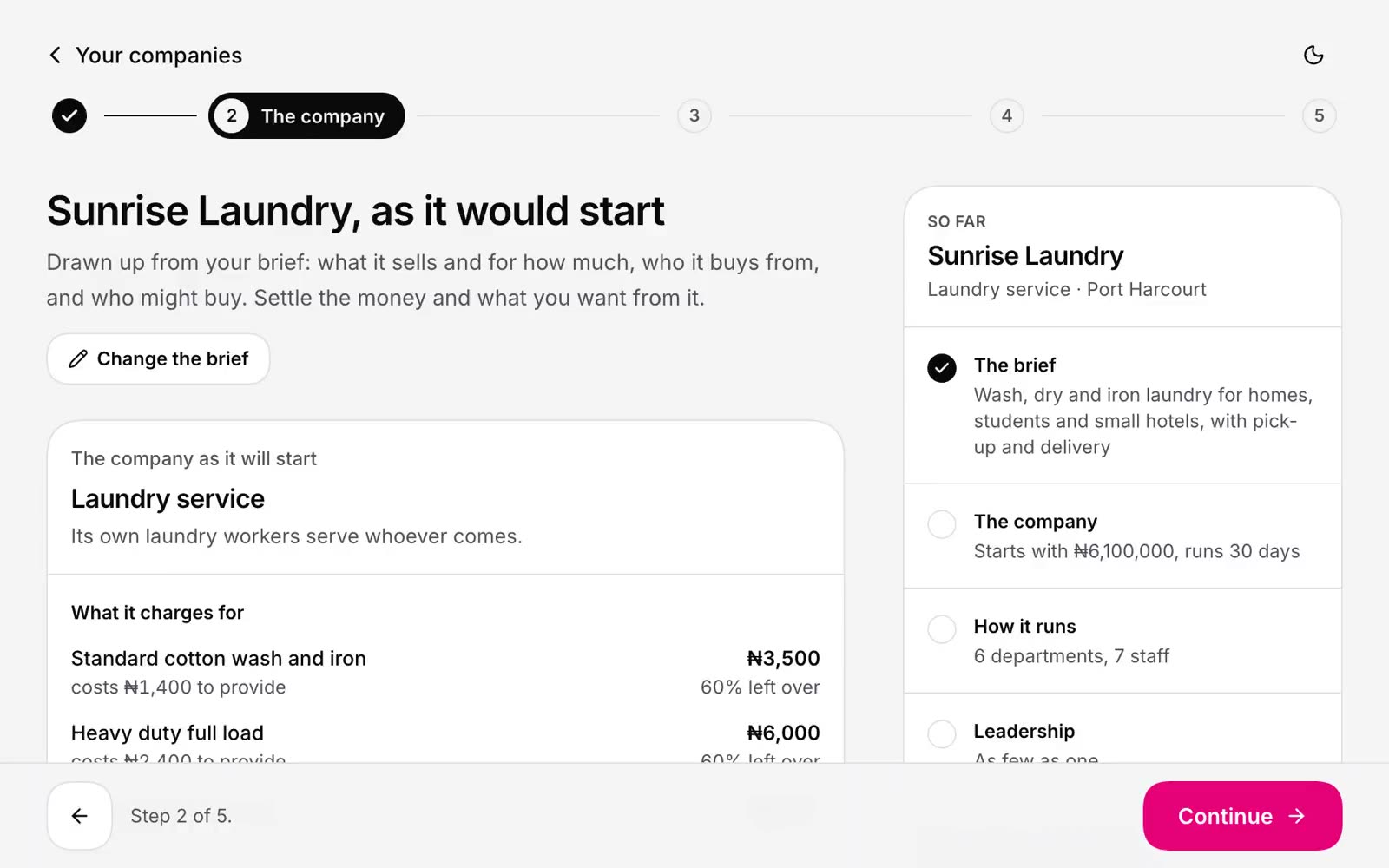
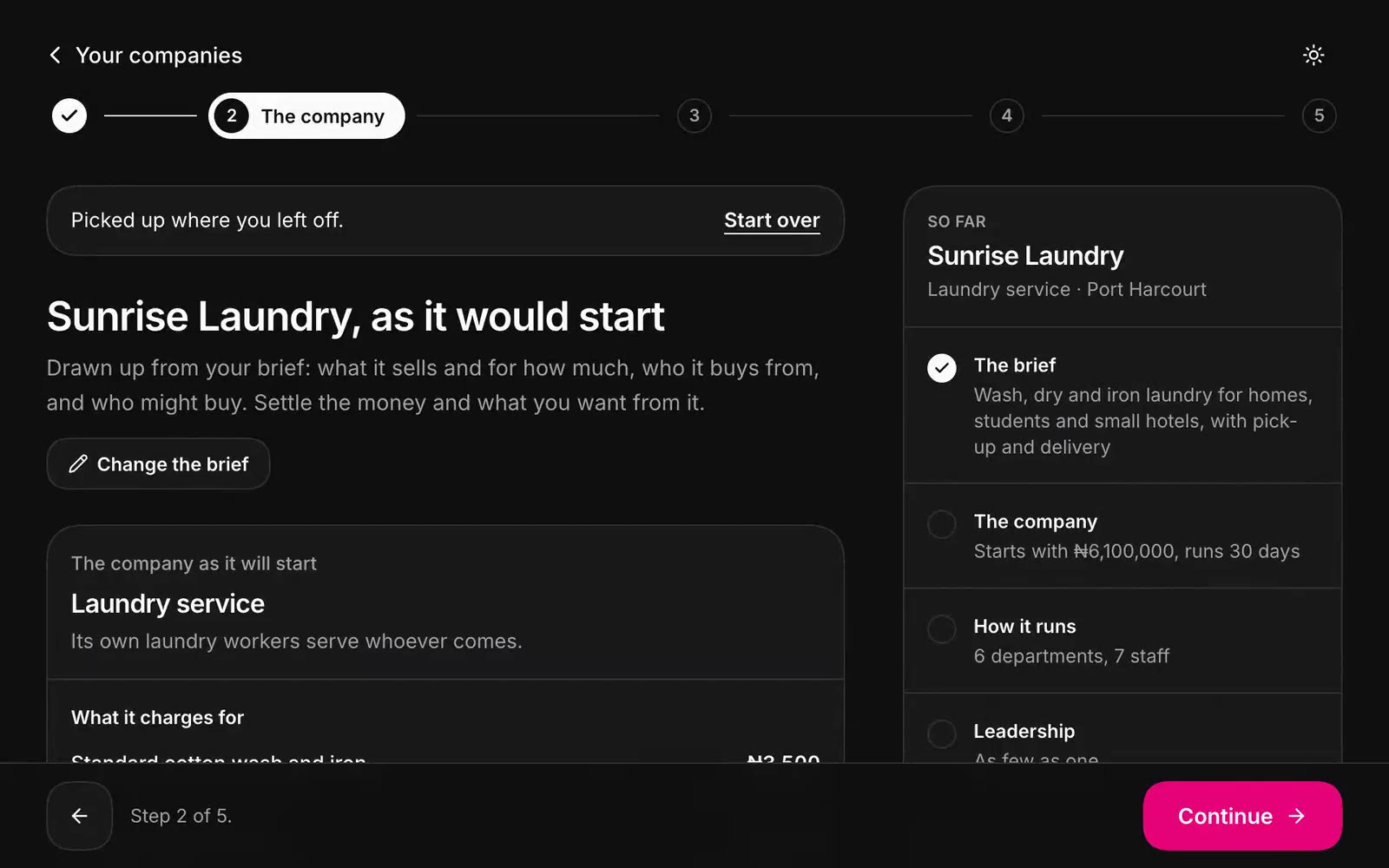
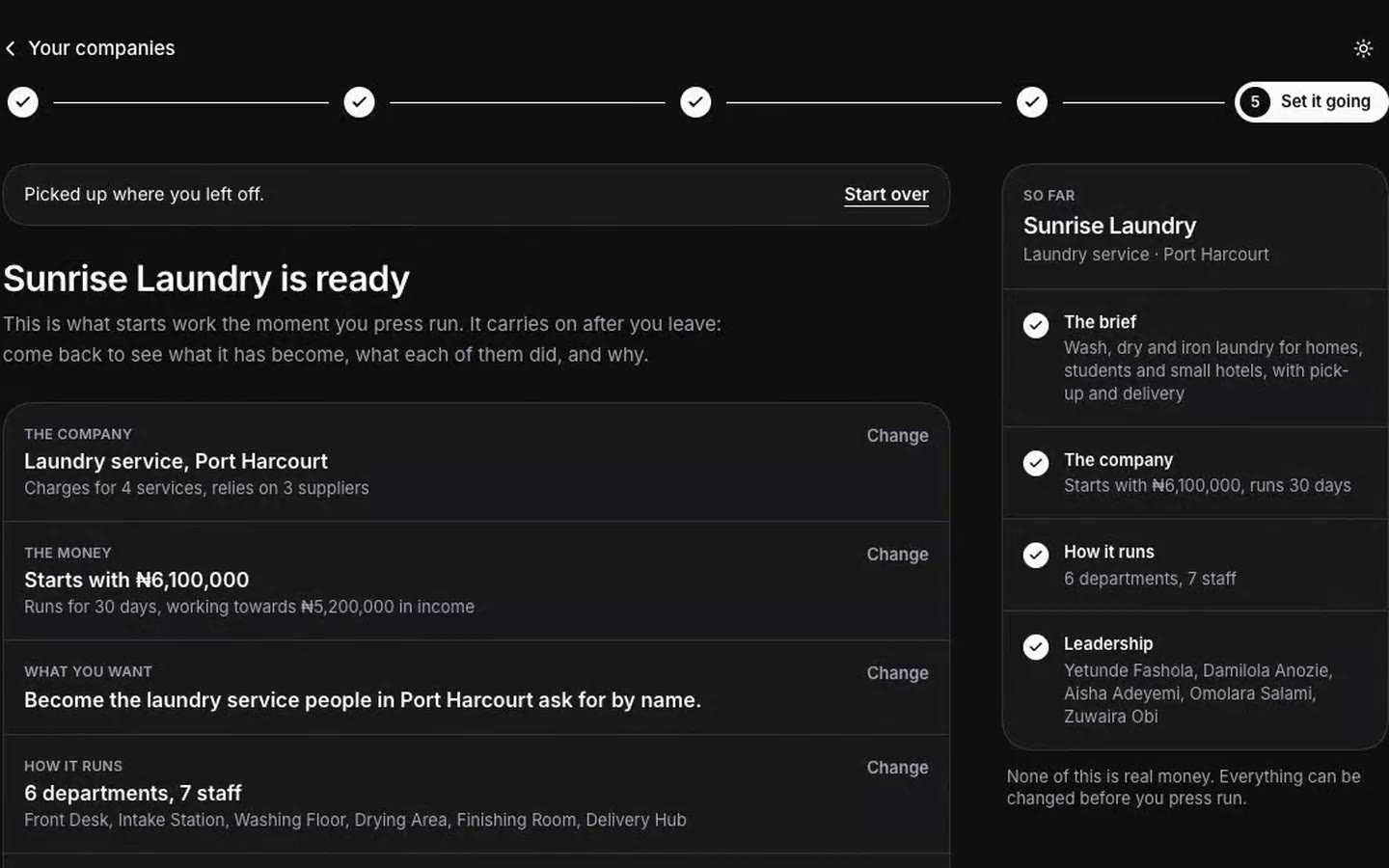
    “Wash, dry and iron laundry for homes, students and small hotels, with pick-up and delivery.” That is all that was written. A minute later the company was drawn up: what it charges and what each service costs to provide, who it buys from, and ten places nearby that might become regulars.

    Sunrise Laundry, as it would start
    The company as drawn up from one sentence: four services with their prices and costs, three suppliers and the money it starts with.The company as drawn up from one sentence: four services with their prices and costs, three suppliers and the money it starts with.
  2. 02Minute two

    You hire who runs it.

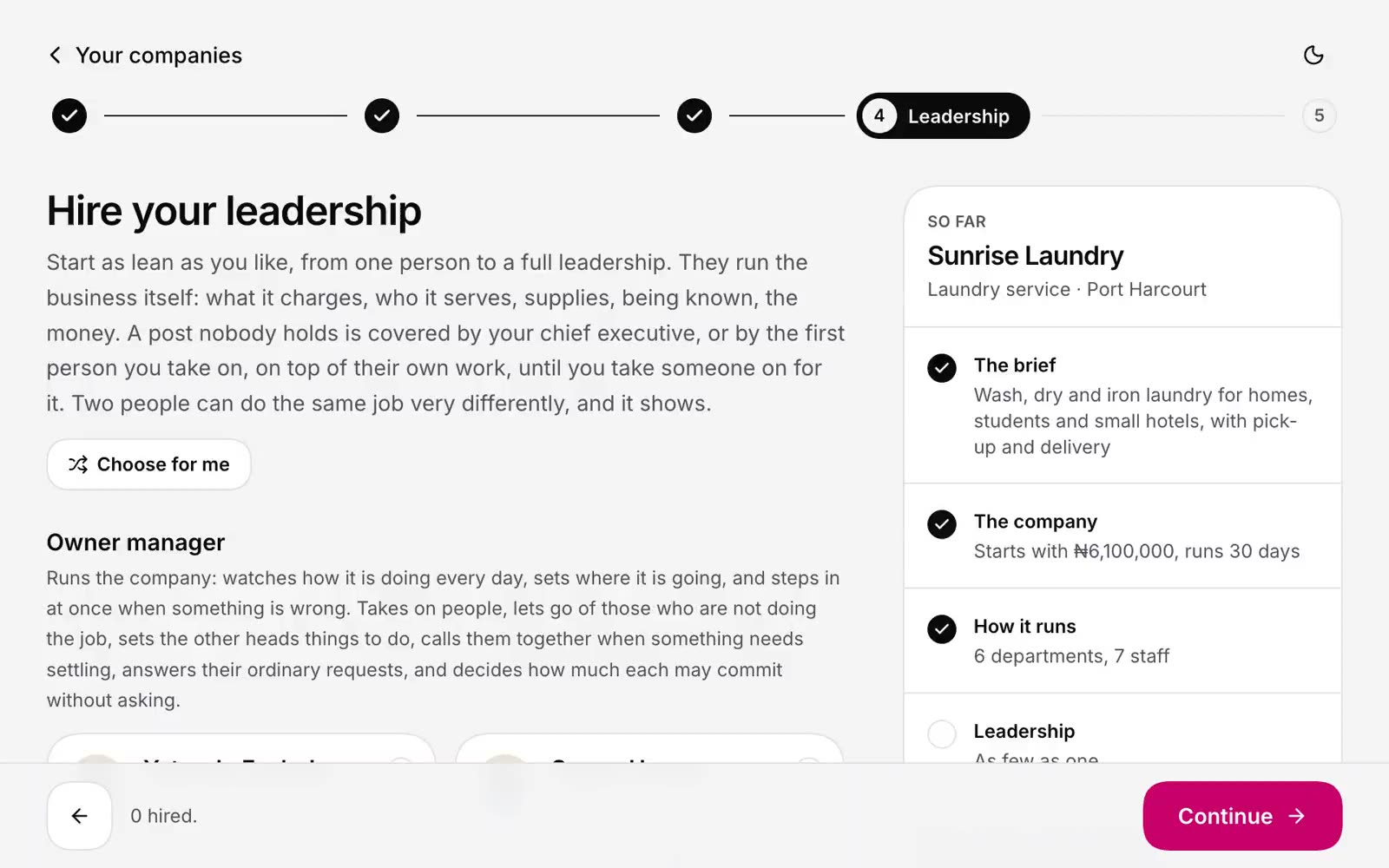
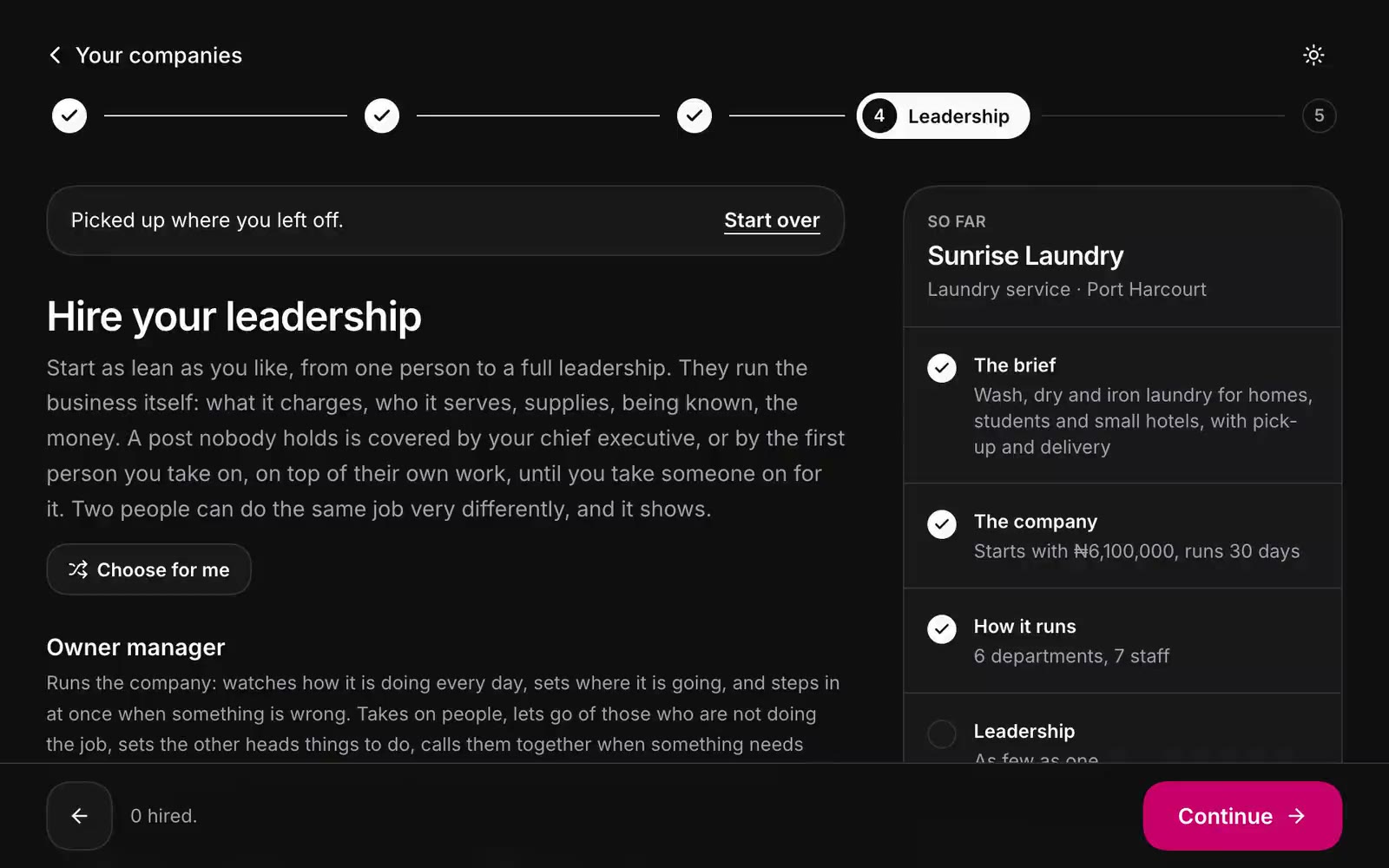
    A patient manager or an ambitious one. A sales lead who wins people over, or one who is sharp on price. Take on one person or five. Two people do the same job very differently, and it shows in the books.

    Hire your leadership
    Choosing five people to lead the company, each with a different way of working.Choosing five people to lead the company, each with a different way of working.
  3. 03Minute three

    You press run, and leave.

    They start work at once. Supplies are ordered, a campaign goes out, the first customers walk in. Nobody waits for you. Close the tab and get on with your day.

    Sunrise Laundry · Running
    Pressing run, and the company’s building coming to life with its people at work.Pressing run, and the company’s building coming to life with its people at work.
  4. 04Day 3

    Every decision has a name and a reason on it.

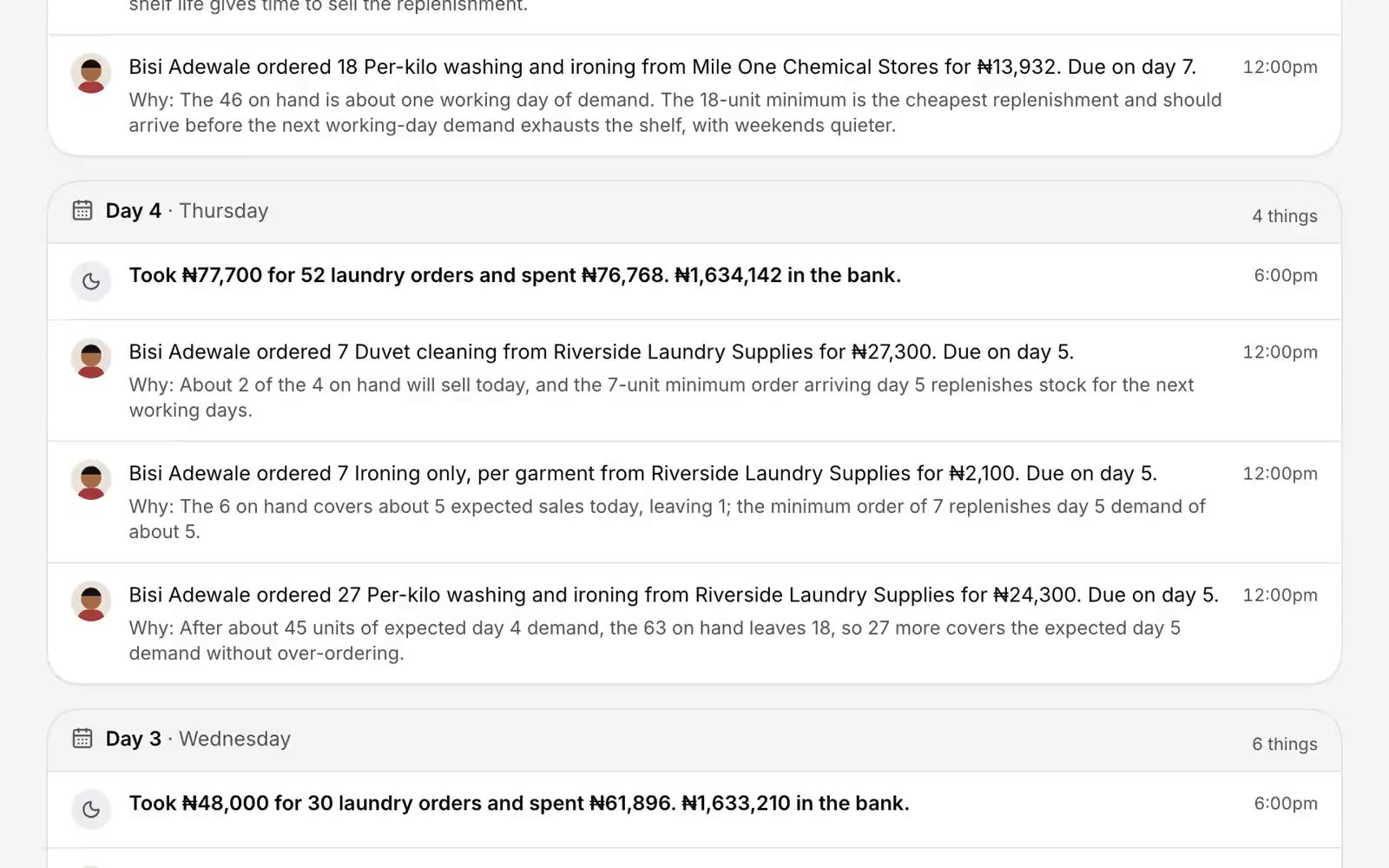
    A hotel refused the price, so the head of sales offered 20% off and won twelve kilos a day. One rider could carry 14 orders and 35 were coming, so operations took on two more. You never have to wonder why something happened. It is written down.

    “The existing rider can deliver 14 orders a day, below the roughly 35 standing orders expected from tomorrow.”

    Bisi Adewale, head of operations
    Sunrise Laundry · Record
    The company’s record: each thing done, who did it, and the reason they gave.The company’s record: each thing done, who did it, and the reason they gave.
  5. 05Day 9

    It has a bad week.

    On day 6 the shelf ran out and twelve customers left unserved. On day 9 it was worse: 18 people turned away and 26 of 33 hotel orders missed. The company was now worth less than on the day it opened. Nobody hid it.

    What it was worth, day by day
    Out of stockStarted with ₦1.70mDay 1Day 10Day 20Day 30

    Worth on day 9₦1.69mbelow where it started

  6. 06Day 10

    It changes course by itself.

    The chief executive put reliable service ahead of growth. Operations stopped trusting the slow supplier. Then came a public holiday, a rival selling at a third off, and a supplier shut for three days. It kept every promise it had made, and kept climbing.

    “On day 9, 19 walk-in customers went unserved and 26 hotel orders were missed; avoid repeating this during the holiday surge.”

    Femi Adeyemi, chief executive
    What it was worth, day by day
    Out of stockStarted with ₦1.70mDay 1Day 10Day 20Day 30

    Worth on day 20₦1.77mabove where it started

  7. 07Day 30

    It ends ahead.

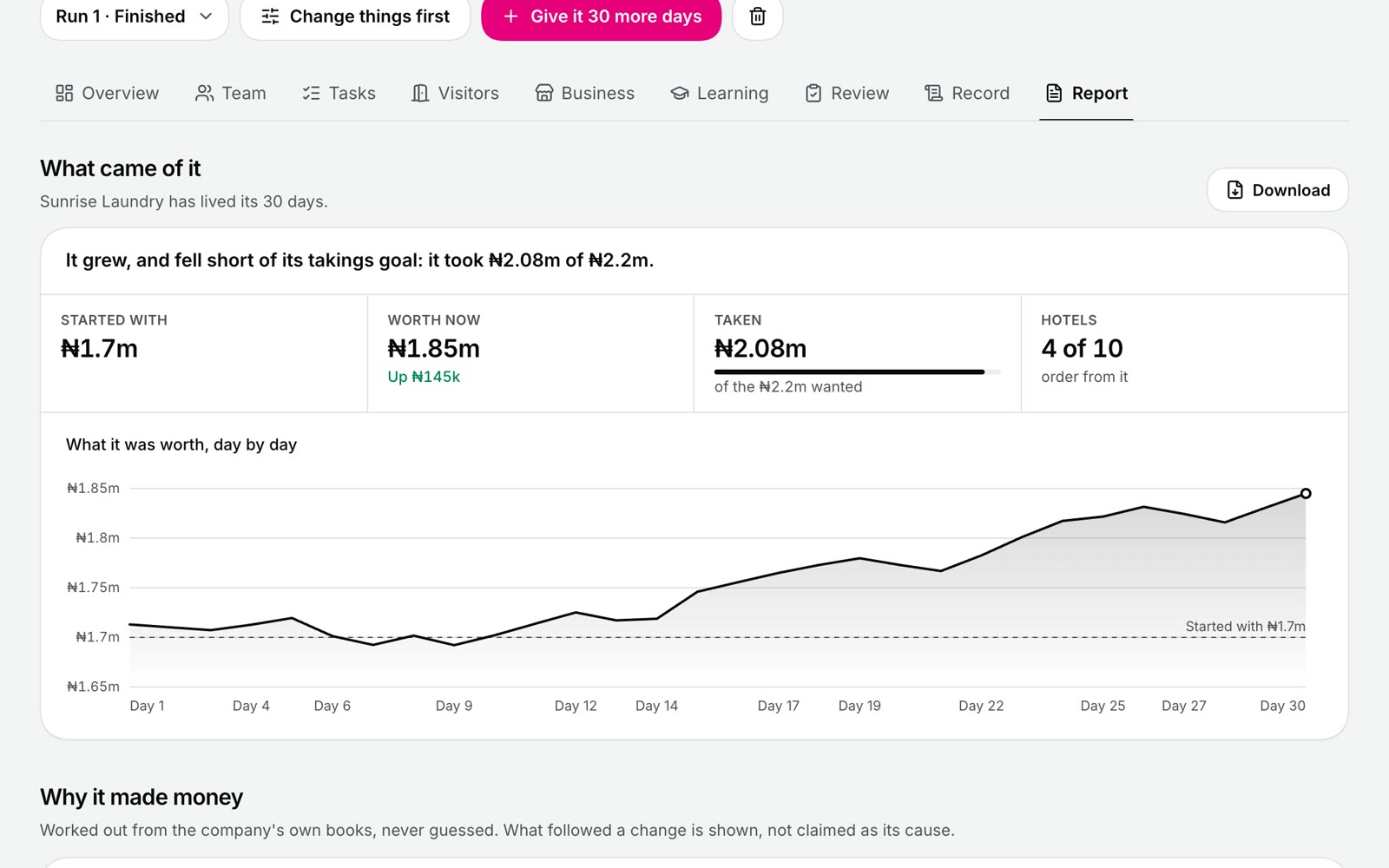
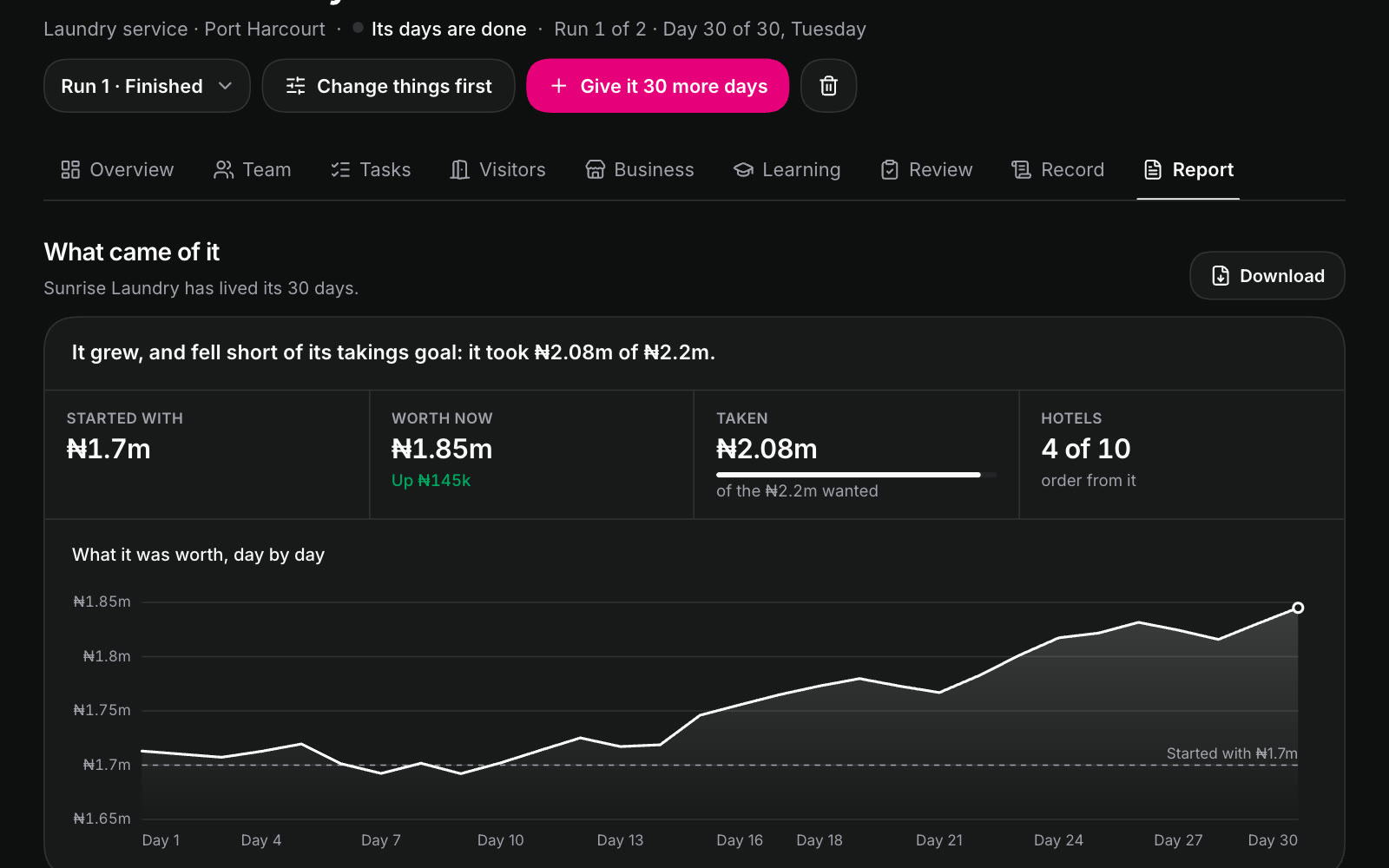
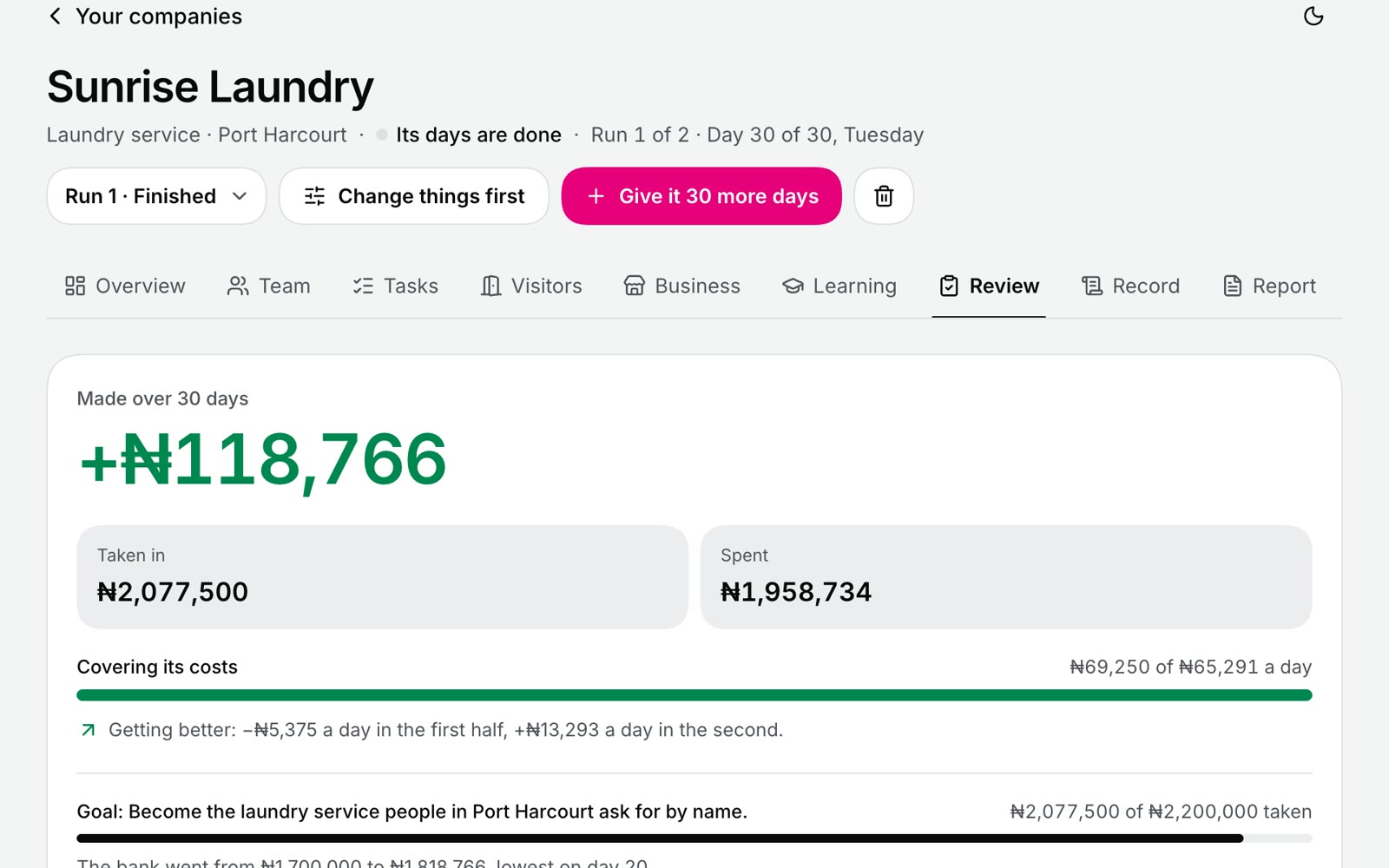
    It lost ₦5,375 a day in its first half and made ₦13,293 a day in its second. It finished ₦118,766 up, with four hotels on standing orders. It also fell short of the takings you asked for, and its head of finance told you so eight days before the end.

    Sunrise Laundry · Review
    The review of the run: made ₦118,766 over 30 days, getting better from the first half to the second.The review of the run: made ₦118,766 over 30 days, getting better from the first half to the second.

While you were away

114 decisions. None of them yours.

Five people ran Sunrise Laundry for thirty days. They won hotels, hired riders, ordered stock, ran campaigns and told the owner when the goal was slipping. Each decision carries the name of whoever made it and the reason they gave.

days lived
30
days lived
hotels won
4
hotels won
people running it
5
people running it
  • Ibrahim MusaHead of salesDay 1

    Won Cedar Point Suites: about 8 kilos of washing and ironing every working day at ₦1,500 each.

    Why: It could bring about ₦12,000 per working day at the current price, supporting repeat business without discounting.

  • Bisi AdewaleHead of operationsDay 3

    Took on a rider. There are now 3, enough to deliver 42 laundry orders a day.

    Why: A second additional rider brings total delivery capacity to 42 orders a day, enough for the projected standing orders.

  • Femi AdeyemiChief executiveDay 7

    Told the team: prioritise fulfilling every order reliably and resolving the day 6 service shortfall.

    Why: Twelve customers went without service on day 6, so reliable fulfilment needs immediate priority.

  • Femi AdeyemiChief executiveDay 10

    Told the team: fulfil every confirmed order, and prepare reliable capacity for the holiday on days 14 and 15.

    Why: On day 9, 19 walk-in customers went unserved and 26 hotel orders were missed; avoid repeating this during the holiday surge.

  • Zainab BelloHead of marketingDay 20

    Started a WhatsApp and Instagram campaign: ₦850 a day for 3 days.

    Why: Operations confirms about 7 daily delivery slots free, so a minimum-spend, short test is within confirmed headroom.

  • Hadiza AbubakarHead of financeDay 22

    Wants you to know: the day 30 takings goal is not on pace. ₦884,800 remains over 9 days.

    Why: The known confirmed demand is about half the required pace, and the team cannot safely chase the shortfall without verified capacity.

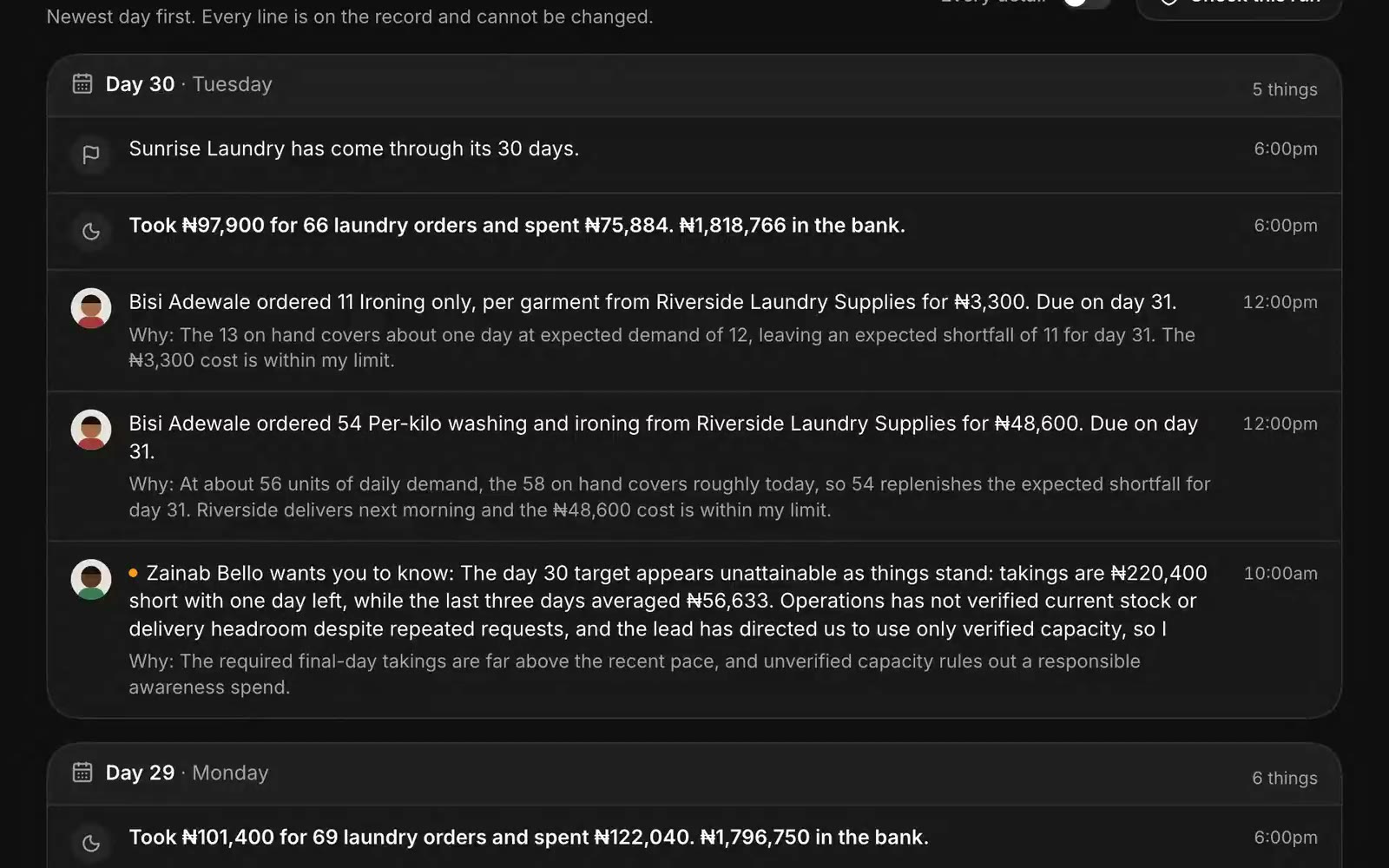
  • Zainab BelloHead of marketingDay 30

    Wants you to know: the day 30 target appears unattainable as things stand, so no campaign today.

    Why: The required final-day takings are far above the recent pace, and unverified capacity rules out a responsible awareness spend.

It runs without you. It is still yours.

A company you run, not one you watch.

  1. Give it work, and get a document back.

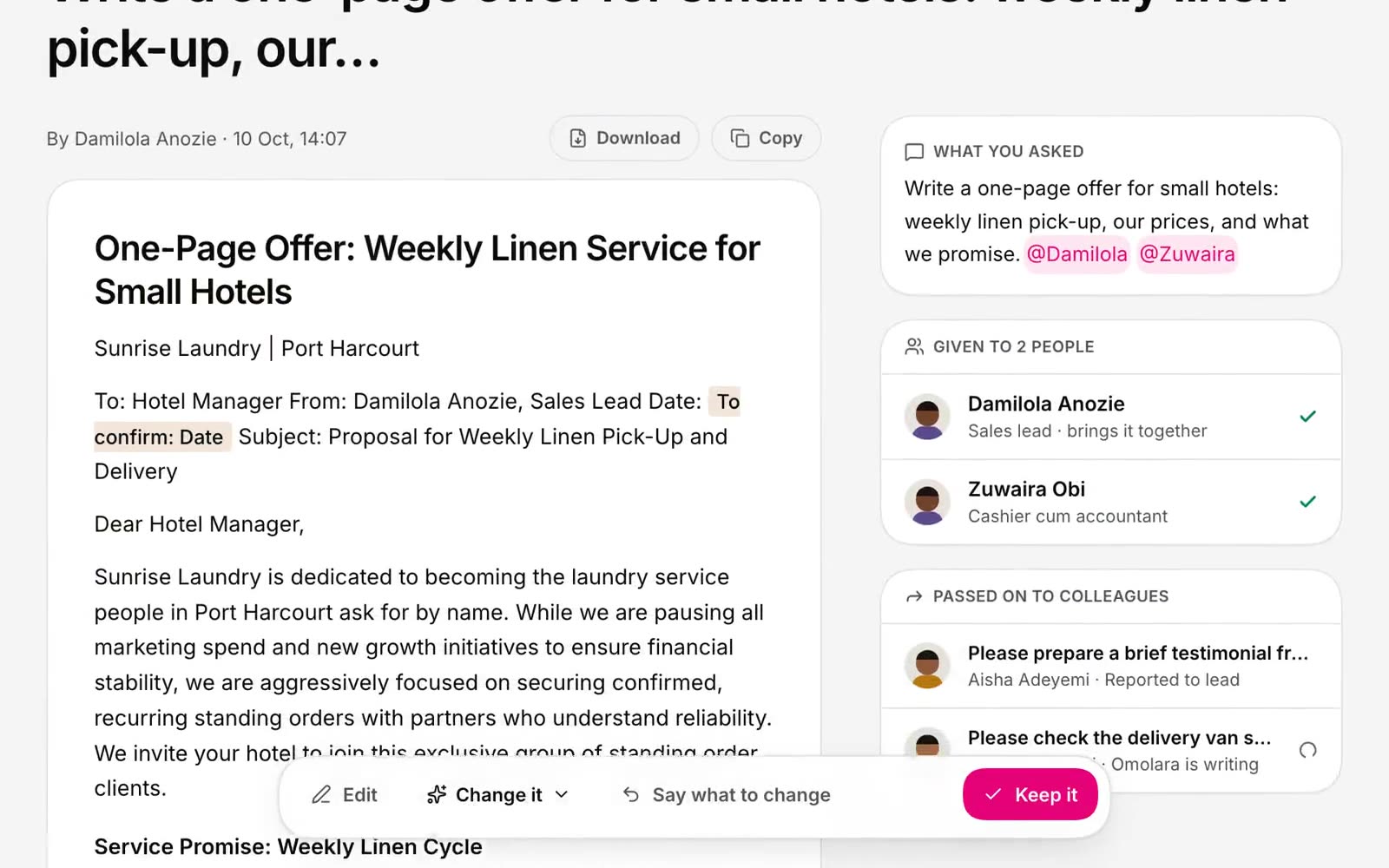
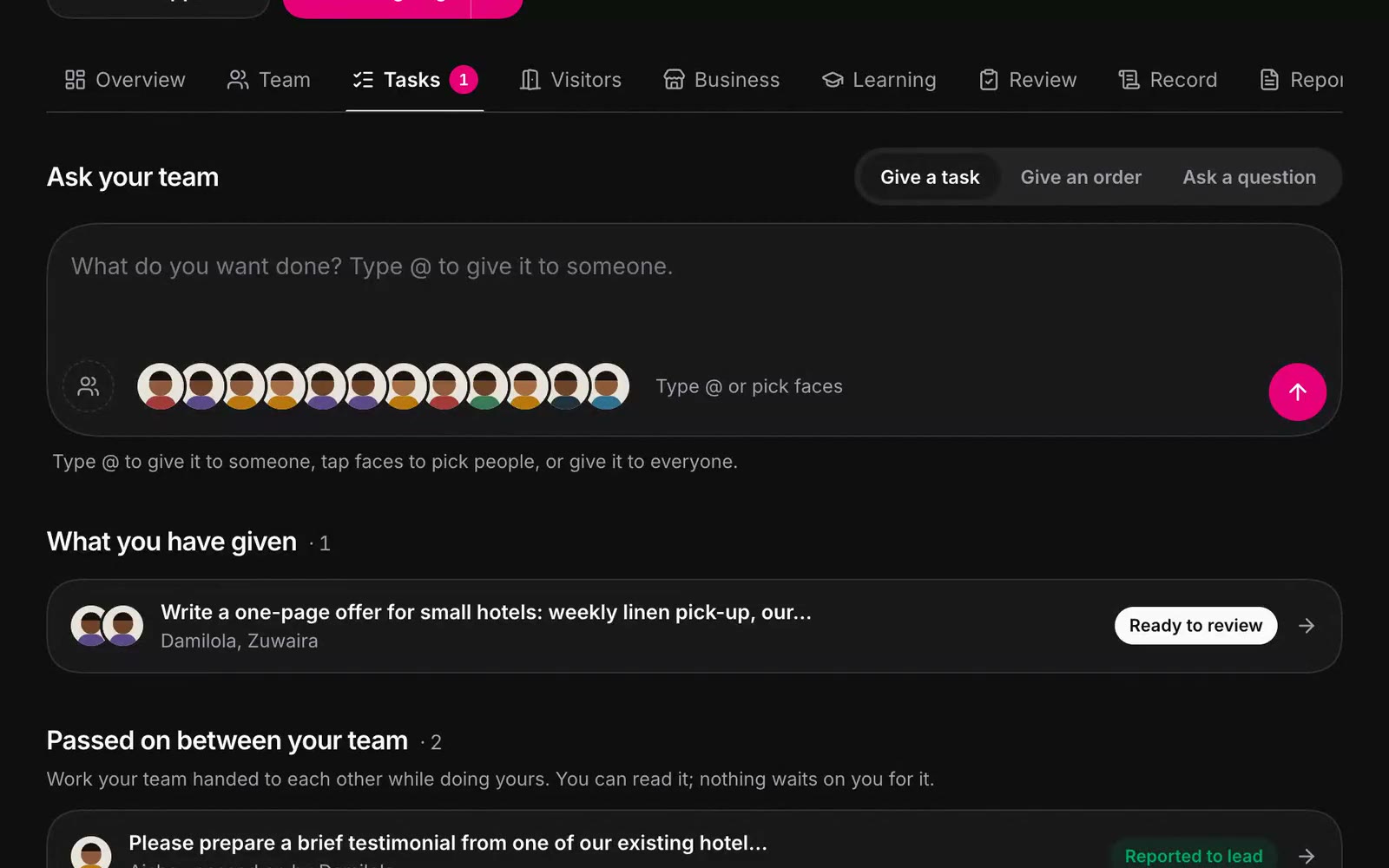
    Ask for a price list, an offer for hotels or a plan for the holiday. The people it belongs to each write their part and the lead joins them into one document. Mark a passage and send it back, and only that passage is put right.
    Sunrise Laundry · Tasks
    Giving the team a task and reading the document they wrote.Giving the team a task and reading the document they wrote.
  2. Walk in as a customer.

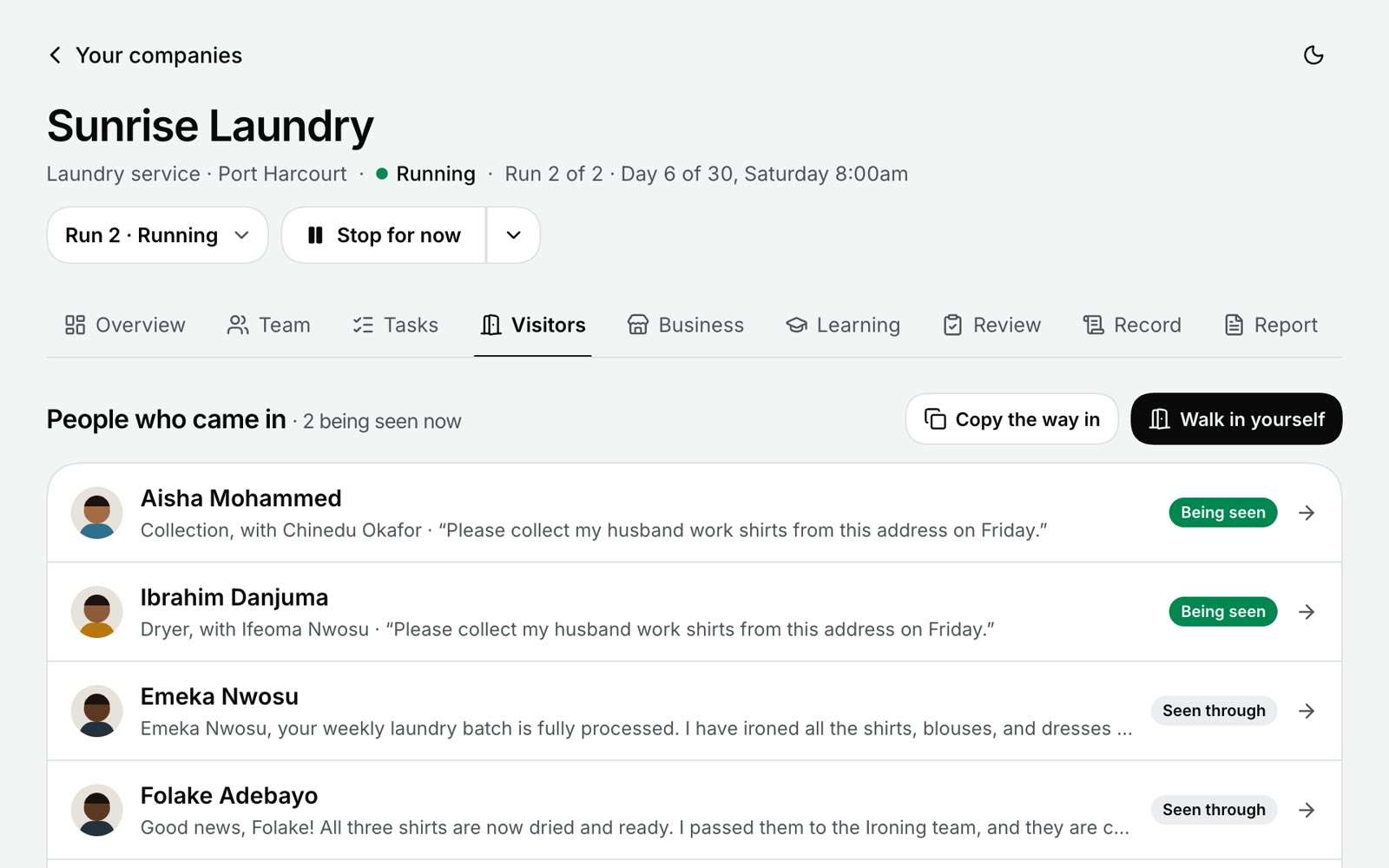
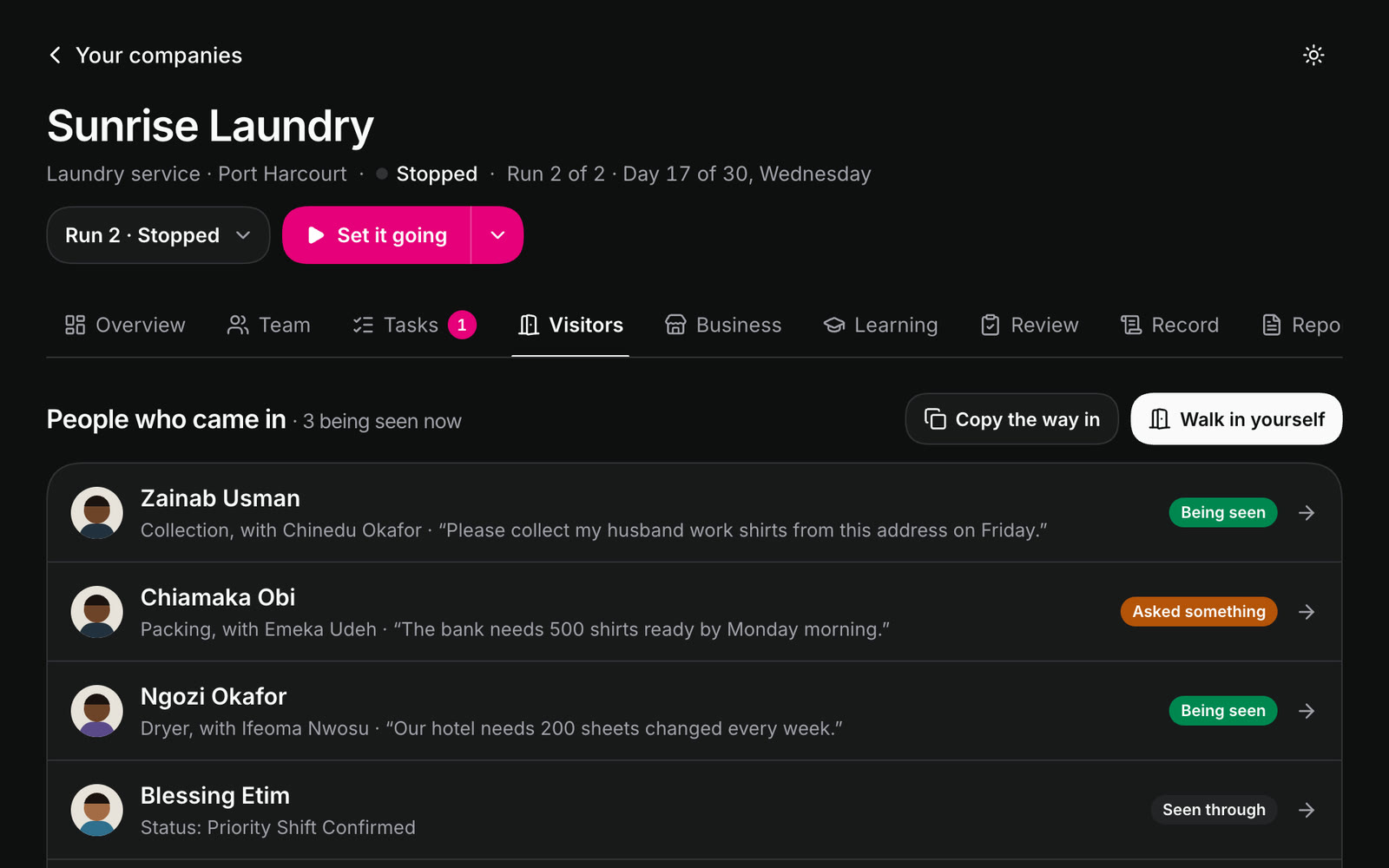
    Come through the door yourself, say why you have come, and be passed from the front desk to whoever serves you. Find out how your own company treats people before a real customer does.

    Sunrise Laundry · Visitors
    A visit to the company: the person at the front desk taking the details of someone who came in.A visit to the company: the person at the front desk taking the details of someone who came in.
  3. Step in whenever you want.

    Give an order, answer a request only you can answer, change the prices or the goal, replace someone who is not doing the job. Or do nothing at all. It is your company either way.

    Sunrise Laundry · Overview
    The company’s overview: its building, the money, and a box to give the team a task, an order or a question.The company’s overview: its building, the money, and a box to give the team a task, an order or a question.
  4. Change one thing and run it again.

    What the team learned is written down and read before every decision in the next run. Keep the lessons, change the price or the people, and see whether it comes out better. That is the whole point of running it here first.

    Sunrise Laundry · Report
    The report of a finished run: what it started with, what it is worth now, and its worth day by day.The report of a finished run: what it started with, what it is worth now, and its worth day by day.

Not only laundries

Any organisation that serves people.

A hospital has triage, a doctor and a pharmacy. A software company has engineers, sales and support. A school has admissions and an exams officer. Say what yours does and its rooms, its staff and how each of them works are drawn up to match. Or start from one of these.

Who it is for

For anyone about to bet on a business.

  • A man at a table late in the evening with a notebook of sums, thinking.

    Thinking of starting something

    Put the shop, the clinic or the school through a month before you spend on it. See what it costs, where customers get turned away and what a team would do about it.

  • A shop owner writing in her ledger behind the counter.

    Already running one

    Describe your business, or let it be read from your website. Try the price rise, the new hire or the second branch here, and see what it does before you do it for real.

  • A lecturer and three students round a laptop, mid-discussion.

    Learning, or teaching

    Run a company of your own choosing instead of a set exercise. Every decision comes with its reason, so there is always something to argue about.

Nothing is taken on trust

A model can say anything. Here it cannot.

The people on your team are AI models, and models make things up. So they are never allowed to touch the books. Any run can be checked, by you, from the screen it ran on.

  1. They propose. Rules decide.

    Nobody on the team can change a figure. Each says what they would do, and the company’s own rules allow it or refuse it. At Sunrise Laundry 197 moves were proposed and the rules refused five.

  2. Every decision is kept.

    What each person could see, what they did and the reason they gave, for every decision, kept for good and never edited.

  3. Any run can be lived again.

    From its starting number and its decisions alone, a run comes out exactly the same. If it did not, the check would say so.

Checking PlugPoint
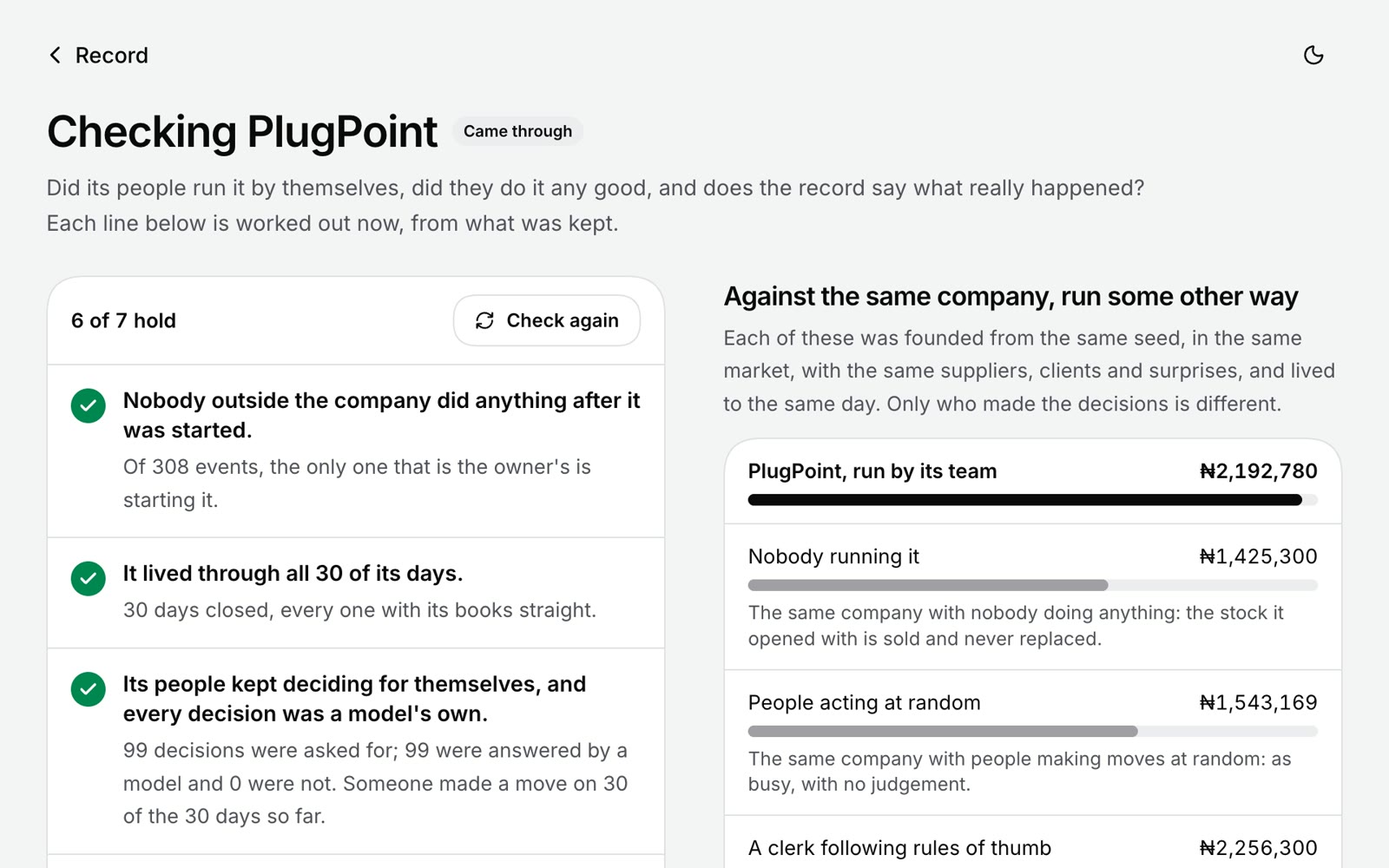
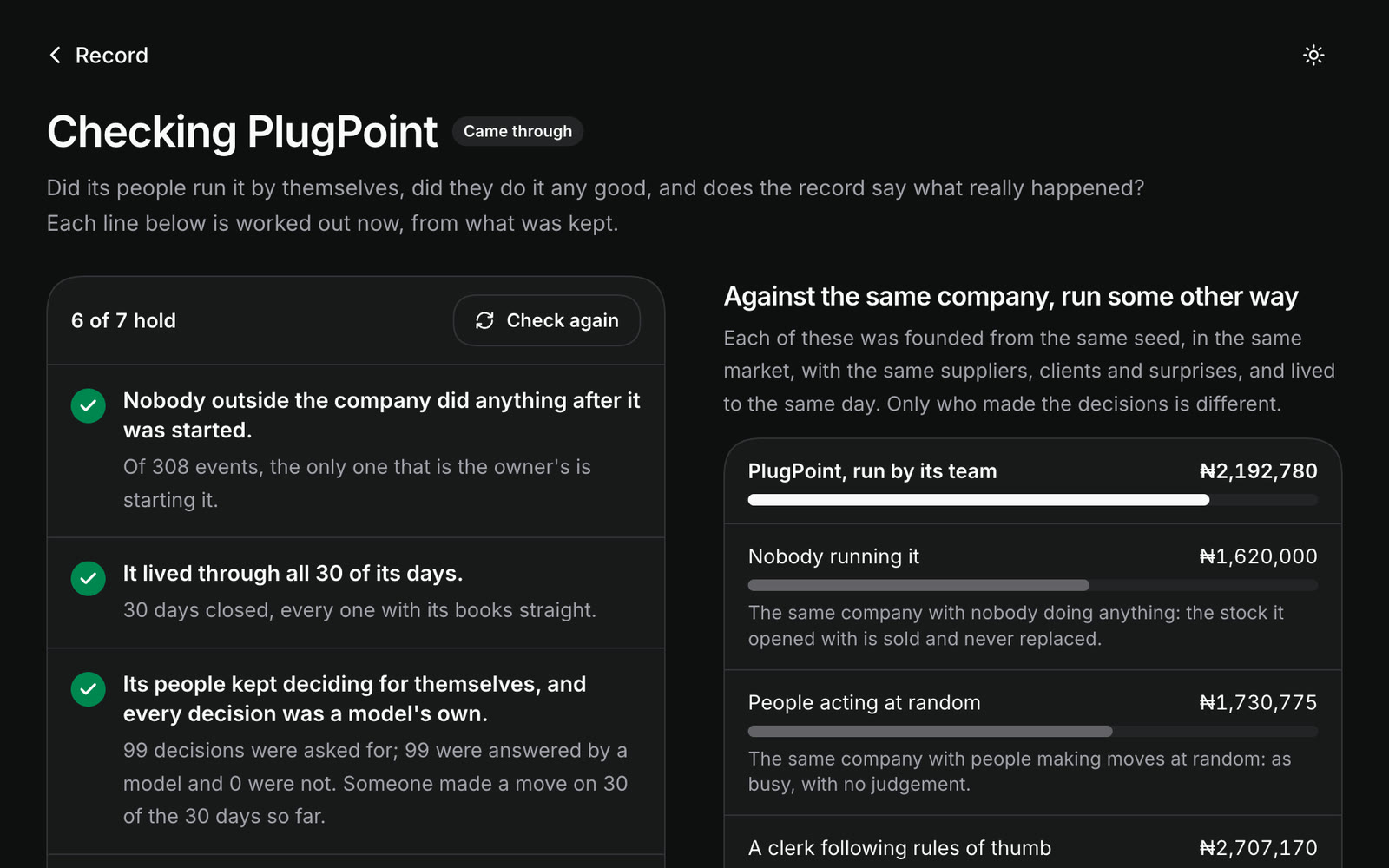
The check of a run: seven things that must hold, each worked out from what was kept, and the same company run three other ways for comparison.The check of a run: seven things that must hold, each worked out from what was kept, and the same company run three other ways for comparison.

The check of another company, PlugPoint, a phone accessories kiosk in Kano that was started and never touched again.

What it costs

Free to start. Cheaper than one wrong hire.

You pay for the work your team does, in credits: one each time someone decides, serves a visitor or writes part of a task. A credit is $0.01.

  • FreeStart here

    $0

    No card needed

    500 credits, once

    1 company

    Enough to start a company and run it for thirty days.

  • Starter

    $5a month

    Stop it at any time

    1,500 credits a month

    2 companies

    Two companies running every day of the month.

  • Growth

    $15a month

    Stop it at any time

    5,000 credits a month

    5 companies

    Five busy companies, with room for tasks.

  • Business

    $40a month

    Stop it at any time

    15,000 credits a month

    No limit

    As many companies as you run, all month.

CustomTerms of your own

Running more than Business covers?

Many companies, a set budget, invoices, another currency. Say how much you mean to run, see what it comes to, and a person writes back with terms.

Work out a custom plan

Questions people ask.

Is any of the money real?

No. Each company has its own pretend money inside Livar. Nothing you run here can cost you anything real, which is the point: find out what works first.

How long does it take?

About two minutes to set a company up. Thirty days are lived in under an hour, and it keeps going while you are away.

Does it have to be a business?

Any organisation that serves people or sells something: a shop, a kitchen, a clinic, a school, a law firm, a software company. Say what it does and the rest is drawn up for you to keep or change.

Can I try it in another country?

Yes. Say the city and the company is drawn up for there: prices, wages and rent in the money of that place, and people named as people there are. Run the same company in several cities and compare how each comes out.

Who decides what happens inside?

The people on your team, each an AI model with their own way of working. They propose and the company’s rules decide, so nobody can make up a number.

Will it tell me my idea works?

It will tell you what happened, good or bad. The company on this page fell short of its takings goal and the page says so. A run is a rehearsal, not a promise about the real world.

Can I step in?

At any point. Give a task or an order, answer a request, change the goal, the prices or who holds a post. Then carry on, or run it again from the start.

What does it cost?

Starting is free and comes with 500 credits, enough to run one company for thirty days. A credit is spent each time one of your people makes a decision, serves a visitor or writes part of a task. Plans start at $5 a month.

Open your company in two minutes.

Say what it does, choose who runs it, and leave them to it. Free to start.

Try: